Distributed exposure
Embers can reach more than one vulnerable area. Preparation has to consider the building as a system.
 Request access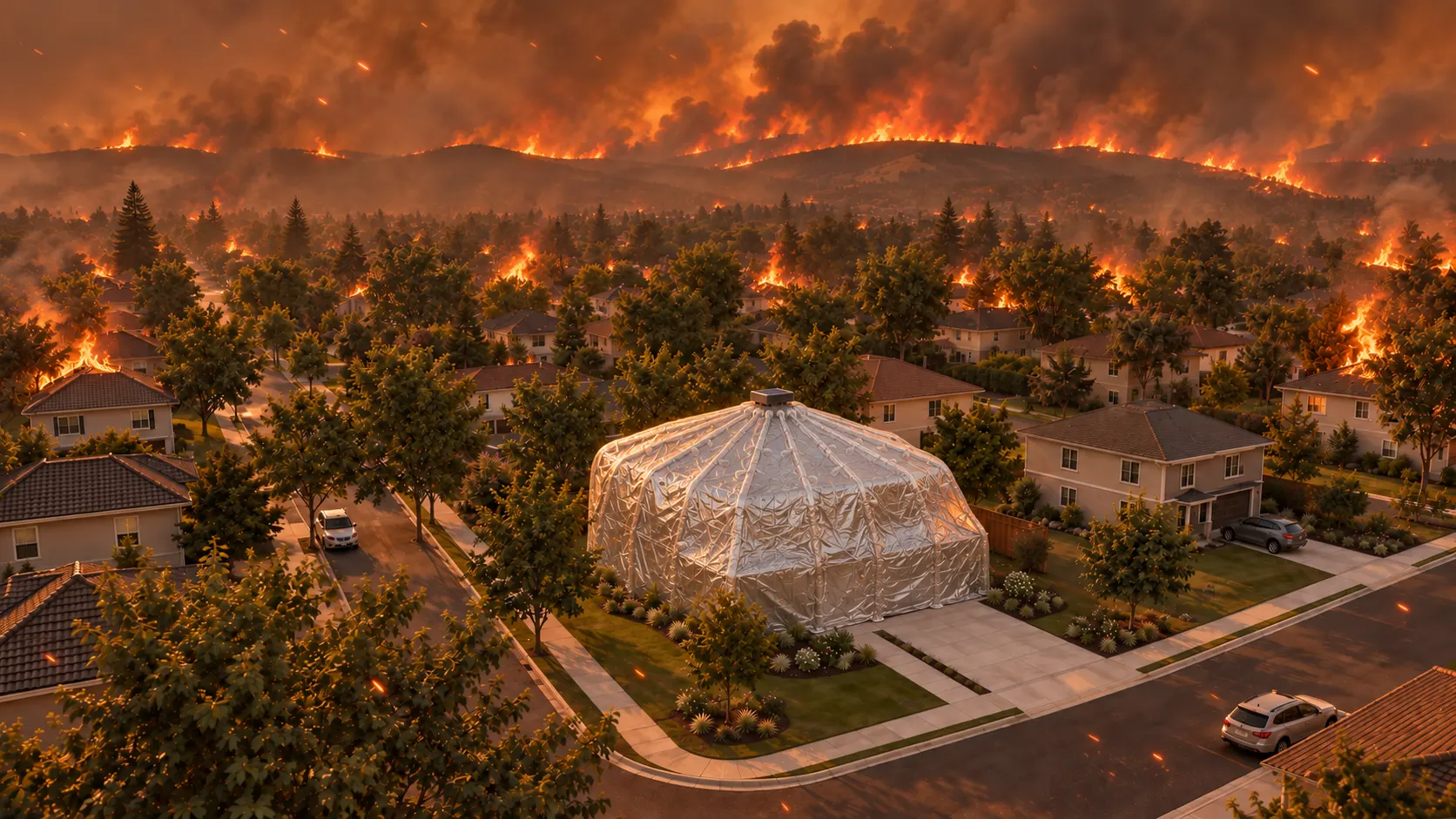
Whole-building wildfire defense
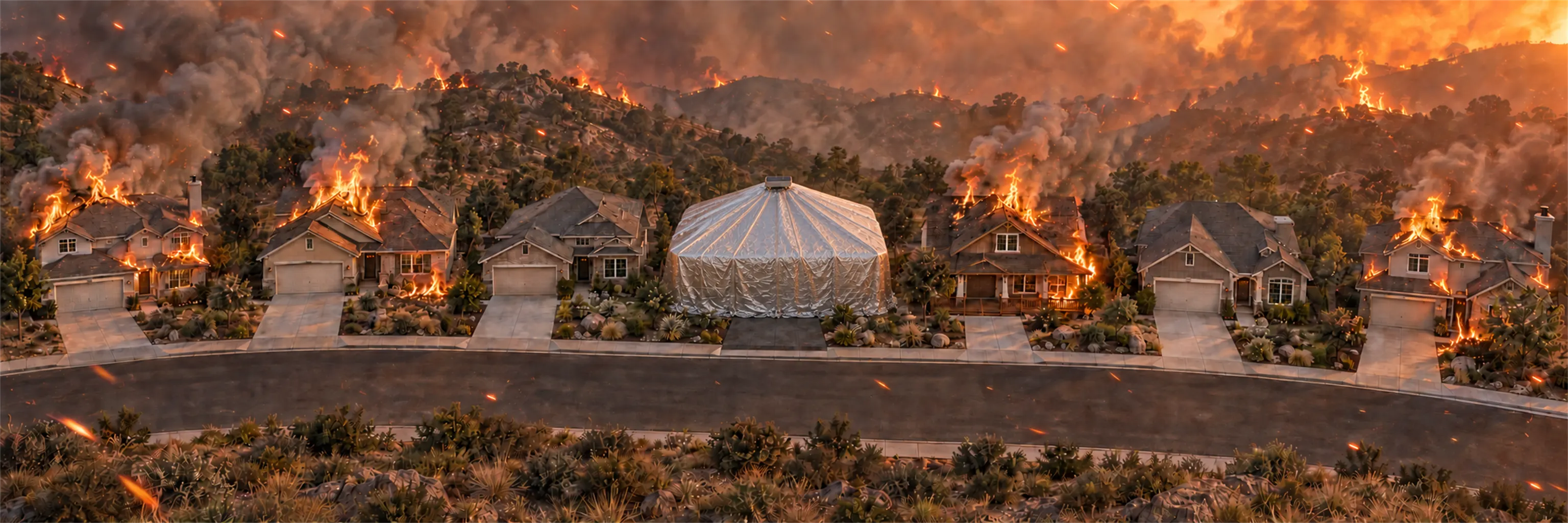
A roof-mounted system designed to deploy a semi-reflective silver envelope over the roof, walls, openings, and perimeter of the home.
Patent pending | Designed for U.S. wildfire-exposed homes
Why this matters
Wind-driven embers can reach roofs, vents, decks, and other vulnerable surfaces before the fire front arrives. PyroVeil brings the physical response to the building itself, ready before people evacuate.
Research context: NIST, Structure Hardening for EmbersEmbers can reach more than one vulnerable area. Preparation has to consider the building as a system.
The concept stores at the roof apex, rather than asking someone to install a wrap during an emergency.
Home hardening and defensible space remain essential. PyroVeil is intended to complement them, not replace them.
The system
A roof-apex cassette stores the system. Pressurized flexible structures deploy the blanket outward and down around the building.
 Pre-deployment | Cassette closed
 Post-deployment | Full enclosure
The cassette stays fixed at the roof apex. Integrated pneumatic structures carry the blanket radially outward and down, without event-time ropes, cables, hoses, water, or external rigging.
See the deployment architectureThe category
Home hardening and defensible space form the foundation. PyroVeil adds an installed, whole-building response designed to act after evacuation, without depending on water delivery or event-time wrapping.
| Defense | Installed readiness | Exterior coverage | Acts after evacuation |
|---|---|---|---|
| Exterior sprinklers | Yes | Spray-limited; supply-dependent | Only while trigger, power, and water remain available |
| Gels / retardants | Requires application | Applied surfaces; temporary | Only while the coating remains effective |
| Manual structure wraps | Requires event-time installation | Potentially broad if fully installed | Yes, but only after manual installation |
| Automated shutters / vent closures | Yes | Openings only | Yes, if automatically triggered |
| Detection-only systems | Yes | No physical coverage | Alerts or triggers only |
| PyroVeil target | Deployable envelope layer |
Building the category
A compact cassette, deployable silver membrane, and integrated pneumatic structure define the core system.
Whole-building exterior coverage designed to deploy after occupants evacuate, without event-time installation.
Prototype packaging, repeatable deployment, wind and ember testing, property fit, installation, and serviceability.
First homes
We are prioritizing wildfire-risk homes, second homes, builders, and communities experiencing insurance pressure.
Homeowner questions
PyroVeil is in product development and is not commercially available. Requesting pilot access is a research fit screen, not a reservation or availability promise.
We save your consented contact information, property ZIP, profile, and any optional context you provide. The team may contact strong-fit properties as validation progresses. A submission does not confirm compatibility or pilot selection.
A property review will account for roof geometry, building footprint, projections, ground conditions, access, and service needs. Representative property types are part of the development and installation program.
No. Defensible space, ember-resistant construction, and local evacuation instructions remain essential. PyroVeil is being developed as a potential additional exterior layer, not a shelter for people or a reason to delay evacuation.
For investors
Explore the product insight, initial U.S. market, commercial model, and evidence-led path to scale.